PLAYBOOK · SALES & REVOPS
Private sales intelligence grounded in your CRM.
Reps want briefings, recap notes, and follow-up drafts grounded in their actual account history. This playbook registers Salesforce, HubSpot, or your custom CRM as a Custom API tool and binds it to a sales agent network.
Sales reps want briefings, recap notes, and follow-up drafts grounded in their actual account history — not generic prospecting templates that ignore the last six conversations. VDF AI wraps your CRM as a Custom API tool and grounds every output in account context that is verifiably yours.
The problem
Generic AI emails miss the deal
A rep doesn't need a generic prospecting email — they need one that knows the opportunity stage, the prior conversations, and which competitive notes have been logged.
The VDF AI approach
Account context, sovereign by default
The CRM becomes a Custom HTTP tool. Sales decks and battlecards go into pgvector. A Sales Network drafts intelligence on demand, citing the source for every claim.
WHY THIS MATTERS NOW
Sales context is account-specific by definition
Generic AI prospecting tools struggle with one thing that matters most: the account itself. The competitor mentioned in the last call. The opportunity stage. The specific objection the buyer raised in February. Those details are in your CRM. They are not in any public model.
VDF AI registers Salesforce, HubSpot, or your custom CRM as a Custom HTTP tool. Decks, battlecards, and case studies go into per-segment vector indexes. The Account Briefer Agent stitches them together into briefings reps can actually use — with citations to the CRM activities and battlecards that drove them.
WHAT YOU NEED TO START
Prerequisites for a pilot
CRM access
- Read endpoints for accounts, contacts, opps, activities
- Service account or OAuth flow
- Field-level access policy
- Optional: write endpoint for activity create
Content
- Decks and battlecards (slide or PDF)
- Case studies and references
- Competitor positioning notes
- Pricing & packaging documents
People
- One RevOps lead
- One sales enablement owner
- One marketing partner for battlecards
- Optional: a sales coach for prompt tuning
REFERENCE ARCHITECTURE
Account-grounded sales intelligence
Salesforce / HubSpot
accounts · contacts · opportunities
Intent: prep-account · draft-followup
PLAYBOOK · STEP BY STEP
Make every rep better prepared
Register the CRM as a Custom HTTP tool
OAuth or service account. Define typed endpoints for accounts, contacts, opportunities, and notes.
Vectorize decks, battlecards, and case studies
VDF Data ingests SharePoint, Google Drive, or your DAM. Per-segment indexes scope retrieval.
Author the Account Briefer Agent
System prompt: pull the latest opportunity stage, the last three activities, the competitor mentioned, and the relevant battlecard.
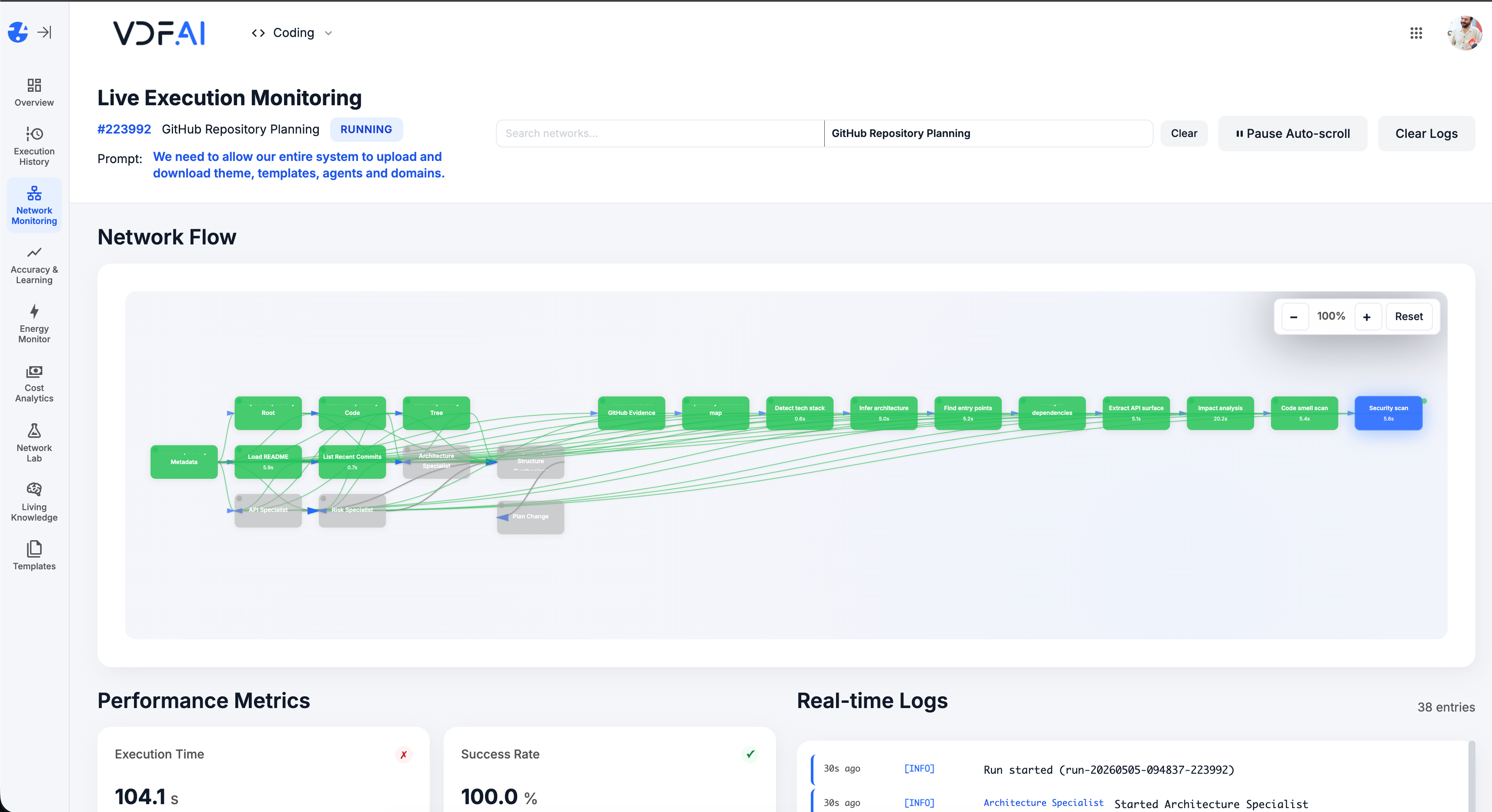
Run as a Network
Intent template prep-account ties the steps. SEEMR sends complex deals to your stronger model.
Ship in the rep's chat
VDF AI Chat or a CRM-side panel — same Network behind both.
OUTCOMES
Better prep, better deals
account briefings per rep, per week.
follow-ups cite a CRM activity or battlecard.
customer data sent to public AI services.
SEEMR REFERENCE
Sales prep that gets cheaper as it scales
SEEMR watches which sub-intent (summary, competitive, action) maps best to which model, balancing cost per brief against quality.
FREQUENTLY ASKED QUESTIONS
What teams ask before shipping this playbook
Will reps trust outputs they did not write?
They trust outputs that cite sources they recognize. Every briefing links to the CRM activities and battlecards it was built from.
How is competitor info kept current?
Battlecards are vectorized and re-indexed on a schedule. Marketing can webhook updates to trigger immediate re-indexing.
Can it draft outbound emails?
Yes — with citations to the CRM activity that justified the angle. Reps edit before send.
Does it work with our existing sales engagement platform?
Yes. Wrap your SEP as a Custom HTTP tool. The Network can drop drafted touches directly into sequences.
How is sensitive deal data protected?
Domains scope agent access by sales segment or geography. Field-level access is honored at tool call time.
How long to pilot?
Three to four weeks: CRM integration, content indexing, prompt tuning, and a 20-rep pilot.
RELATED PLAYBOOKS
Continue with related VDF AI patterns


GET IN TOUCH
You Have Questions
Tell us what you’re trying to achieve—governed AI Networks, enterprise RAG, deep integrations, or on‑premise deployment. We’ll help you map the right architecture, security posture, and rollout path. If you’re moving beyond AI pilots and need scalable, auditable execution, reach out—our team is ready to help.