PLAYBOOK · E-COMMERCE
A no-code agentic backend for the next e-commerce build.
If you're shipping a new e-commerce experience, you don't want to wire dozens of microservices together by hand. VDF AI gives you a multi-agent backend you compose visually — catalog, pricing, recommendation, fraud, support — that learns from every checkout and improves on its own.
A modern e-commerce backend is dozens of microservices stitched with glue code. The teams that ship fastest are now the ones that compose agents instead of writing services. VDF AI gives you a no-code Network you can build visually: catalog, recommendation, pricing, fraud, support — each an agent, each tied to a Custom HTTP tool, each learning from every checkout.
The problem
E-commerce backends are stitched, not built
Catalog, search, recommendation, pricing, fraud, support — each is a separate platform with its own rules engine. Teams spend more time integrating than improving the experience.
The VDF AI approach
One agent network, all the touchpoints
Every back-office system becomes a Custom HTTP tool. Each touchpoint (browse, recommend, price, check out, support) becomes an agent. The Network composes them per session and SEEMR routes by user intent.
WHY THIS MATTERS NOW
E-commerce backends are stitched, not built
Most retailers run dozens of platforms — commerce engine, search, recommendation, pricing, fraud, support. Integration is the dominant cost of every release. Adding AI to the mix without changing that pattern just creates more integrations.
VDF AI flips it. Every back-office system becomes a tool. Every touchpoint becomes an agent. The Network composes them per session. Catalog, recommendation, pricing, fraud, support — one fabric, three ways to create new agents (manual, LLM-generated, on-the-fly).
WHAT YOU NEED TO START
Prerequisites for a pilot
Commerce surfaces
- Catalog and inventory APIs
- Pricing engine endpoint
- Cart and checkout APIs
- Fraud and payments provider
Content
- Product descriptions and metadata
- FAQ and policies
- Brand voice guide
- Case studies and reviews
People
- One product owner
- One commerce engineer
- One CX writer
- Optional: a data scientist for personalization rules
REFERENCE ARCHITECTURE
An agentic backend, visually composed
storefront APIs
Per-session intent
PLAYBOOK · STEP BY STEP
Build the backend without writing the glue
Wrap storefront APIs as Custom HTTP tools
Catalog, inventory, payment, shipping. Each becomes a typed tool the agents can call.
Create agents three ways
Click "new agent" and either (a) fill the structured form, (b) describe the agent in chat and let the LLM generate it, or (c) let a Network spin it up on-the-fly when intent demands it.
Index product content and policies
VDF Data vectorizes catalog descriptions, FAQs, and policies. The Recommendation and Support agents get the same retrieval surface.
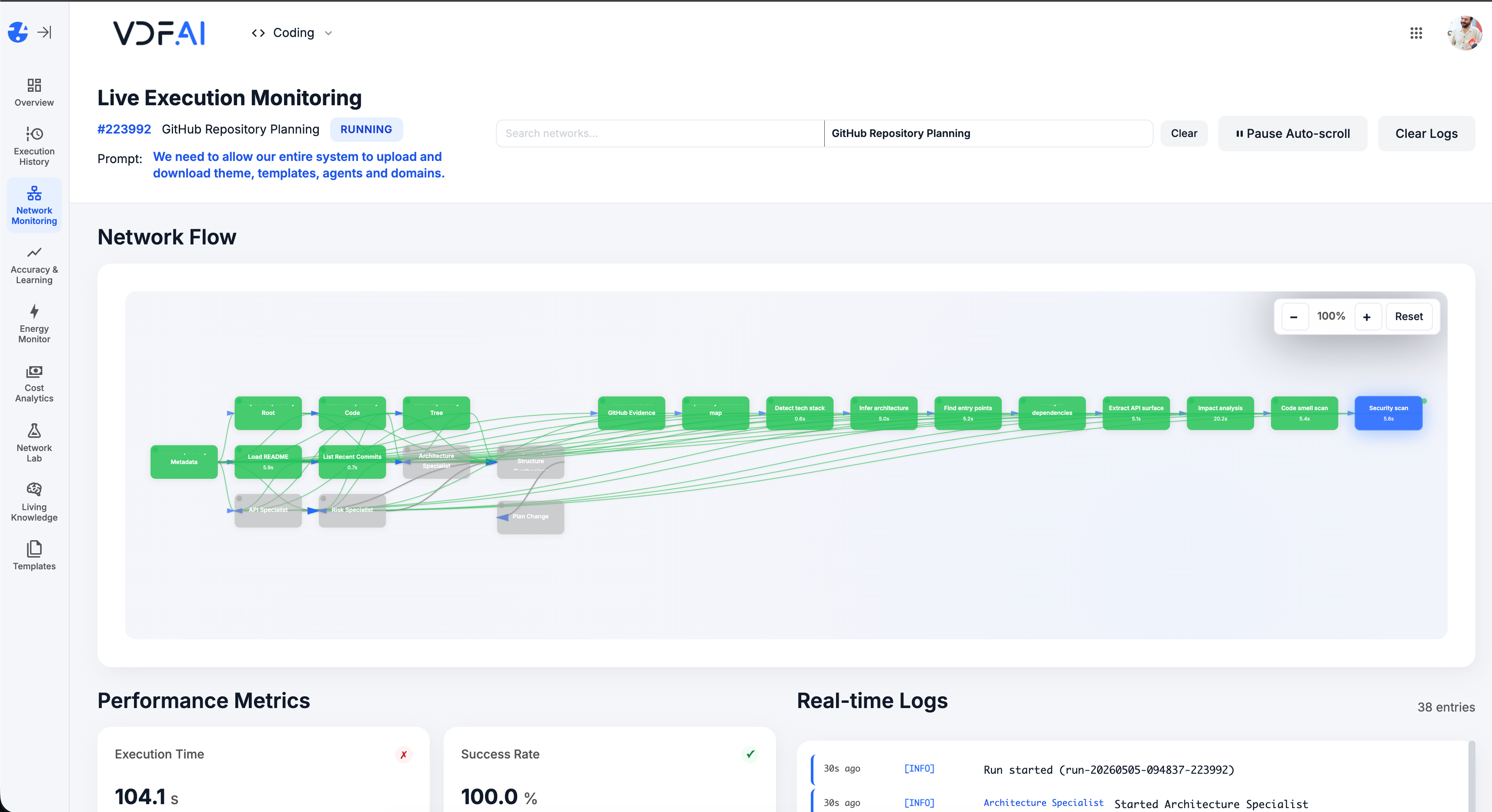
Compose the Network
Drop the agents and tools into Network Labs. Intent rules route browsing, checkout, and support sessions to the right agents in real time.
Learn from every checkout
Conversion, return rate, and CSAT feed SEEMR's learning modes. Prompts, tool choice, and routing keep improving without a release.
OUTCOMES
A backend that gets smarter as customers shop
from concept to a working agentic backend.
boilerplate microservice code written by your team.
conversion improves as SEEMR learns winning sub-flows.
SEEMR REFERENCE
Routing tuned by checkout outcomes
Every successful checkout is signal. SEEMR rebalances which model serves which session segment — small SLMs for routine browse, premium models for high-cart-value sessions.
FREQUENTLY ASKED QUESTIONS
What teams ask before shipping this playbook
Will this replace our existing commerce platform?
No. It composes a smarter front layer over your existing commerce platform.
Can it personalize without violating privacy?
Yes. Personalization uses session and consented profile data only. Domains enforce data scope.
How does fraud detection work?
A Fraud Agent calls your fraud provider as a Custom HTTP tool and contributes to the session decision. You retain veto power.
Can the support flow take refunds?
Yes — through a typed refund tool with policy guardrails and audit trail.
What if we want to A/B test agents?
Networks v3 supports parallel variants; SEEMR uses outcomes to rank them and you can promote a winner.
How long to ship a pilot?
Three weeks for a single category; ten weeks for a full storefront with personalization and fraud.
RELATED PLAYBOOKS
Continue with related VDF AI patterns


GET IN TOUCH
You Have Questions
Tell us what you’re trying to achieve—governed AI Networks, enterprise RAG, deep integrations, or on‑premise deployment. We’ll help you map the right architecture, security posture, and rollout path. If you’re moving beyond AI pilots and need scalable, auditable execution, reach out—our team is ready to help.