PLAYBOOK · LIFE SCIENCES
A regulatory submission assistant built on Living Knowledge.
Regulatory submissions stitch together CMC, clinical, non-clinical, and labeling content. This playbook puts every document into a Living Knowledge graph and lets specialist agents draft and validate each module against agency guidance — all without sending data outside.
A regulatory submission is a knowledge graph in disguise. CMC sections cite batches. Clinical sections cite studies. Labeling cites both. Every cycle, authoring teams rebuild that web by hand. VDF AI captures it once, in a Living Knowledge graph, and lets specialist agents draft and validate each module.
The problem
Submissions are knowledge graphs in disguise
An eCTD module references batches, studies, methods, and labels. Authoring teams reassemble that web by hand every cycle.
The VDF AI approach
One Living Knowledge graph, many specialists
Indexed documents, extracted entities, and relationships sit in a graph. Specialist agents draft each module; a validator checks consistency. Authoring leads review and approve.
WHY THIS MATTERS NOW
Submissions are knowledge graphs rendered as documents
eCTD modules are documents to the regulator and graphs to the authoring team. The same batch number, study identifier, and labeling claim appear across dozens of sections. Inconsistency is the most common reason submissions are rejected at the gate.
VDF AI ingests CMC, clinical, non-clinical, and labeling content into a Living Knowledge graph with entities and relationships. Specialist agents own their sections; a Consistency Validator checks the graph for the kinds of errors humans miss at 11 PM on submission week.
WHAT YOU NEED TO START
Prerequisites for a pilot
Content
- CMC dossier (Module 3)
- Clinical study reports (Module 5)
- Labeling drafts and approved labels
- Prior submissions for the product family
Systems
- EDM / DMS read access
- Submission template manager
- Optional: eCTD publisher integration
- Vault for audit records
People
- One reg-affairs lead
- CMC, clinical, and labeling specialists
- One QA reviewer
- Optional: medical writer for tone
REFERENCE ARCHITECTURE
Graph in, draft modules out
Entities · Relationships · Vectors
Intent: draft-module
PLAYBOOK · STEP BY STEP
From document pile to draft submission
Ingest CMC, clinical, and labeling content
VDF Data extracts entities (batches, studies, methods, products) and relationships into the knowledge graph alongside the vector index.
Define specialist agents
Each specialist owns a sub-area of the submission and follows a strict outline aligned to agency templates.
Wire validation loops
A Consistency Validator checks batch numbers, study identifiers, and dosing across drafted sections, flagging mismatches before the authoring lead sees them.
Author and approve in the Portal
Each drafted section ships with citations to the source documents and to the agency guidance it satisfies.
Operate under audit
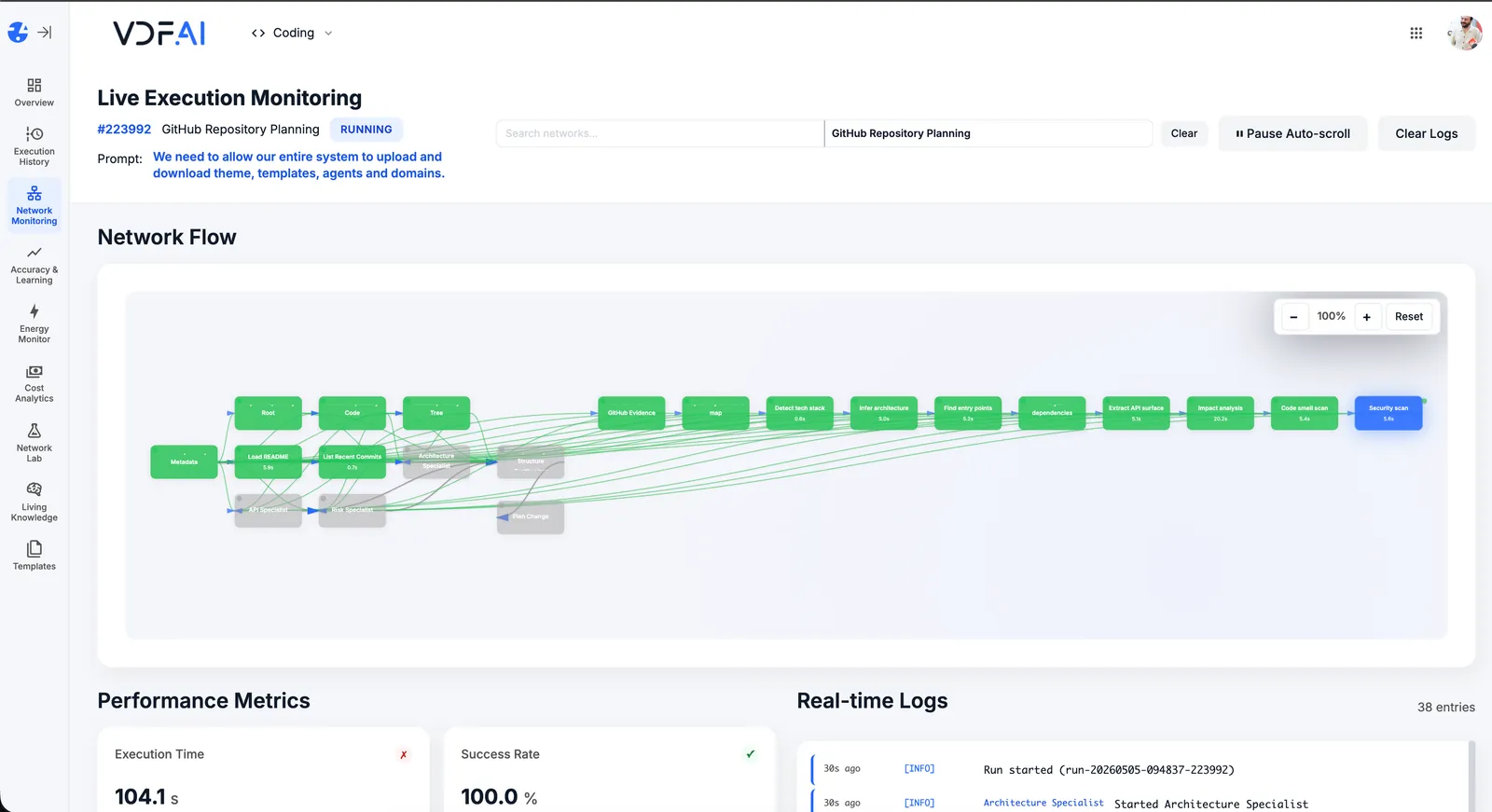
Live Execution Monitoring stores every decision. SEEMR routes heavy reasoning to your high-capability private model.
OUTCOMES
Submission cycles compress, quality holds
authoring cycle time per module.
cross-section consistency issues caught pre-review.
proprietary CMC or clinical content leaves the perimeter.
SEEMR REFERENCE
The graph keeps learning across cycles
SEEMR's Knowledge Graph mode incorporates every approved section as a future retrieval signal. Subsequent submissions start with stronger context.
FREQUENTLY ASKED QUESTIONS
What teams ask before shipping this playbook
Does this replace medical writers?
No. It produces draft sections with citations. Medical writers review, edit, and own the final voice.
How are agency guidance updates handled?
New guidance is ingested into the Living Knowledge graph and surfaced during drafting. Validation checks reference the latest version.
Can we generate full Module 2 summaries?
Yes — the Section Drafter Agents can compose Module 2 from Module 3, 4, and 5 content with cross-section citations.
Is this validated for GxP?
VDF AI exposes every model, prompt, and retrieval step. That transparency is the foundation for GxP validation. The Accuracy Testing module supports IQ/OQ-style protocols.
How is IP protected?
All processing happens on-prem. Domains scope access by therapeutic area or product line. No content leaves the perimeter.
What about cross-product reuse?
Living Knowledge captures reusable assertions (e.g., method validation). Future submissions start with stronger context.
RELATED PLAYBOOKS
Continue with related VDF AI patterns



GET IN TOUCH
You Have Questions
Tell us what you’re trying to achieve—governed AI Networks, enterprise RAG, deep integrations, or on‑premise deployment. We’ll help you map the right architecture, security posture, and rollout path. If you’re moving beyond AI pilots and need scalable, auditable execution, reach out—our team is ready to help.