PLAYBOOK · FINANCE & BANKING
Operate a KYC and AML triage network on your infrastructure.
Customer due diligence, sanctions screening, PEP review, transaction monitoring, SAR drafting — each is a specialist task. VDF AI decomposes a case into the right sub-intents, routes each to the right agent, and keeps a SEEMR-governed audit trail.
KYC and AML are not single decisions — they are a chain of micro-decisions, each of which the bank has to evidence. VDF AI restructures the chain so every link (eligibility, sanctions, PEP, transaction monitoring, SAR drafting) is a specialist agent backed by typed tools, with a Vault-grade audit trail tying them together.
The problem
Compliance teams drown in tickets
Banks process millions of KYC refreshes and AML alerts per year. Each case carries different document mixes, sanctions lists, jurisdictions, and risk profiles. Manual triage scales poorly; rule engines can't reason over freeform evidence.
The VDF AI approach
Specialist agents working in concert
One Network. Five specialist agents — identity, sanctions, transaction, PEP, SAR. Intent template decomposes the case; SEEMR routes per sub-intent; every decision is logged with citations and tool calls.
WHY THIS MATTERS NOW
Financial-crime work is about the trail, not just the result
A passed KYC check that cannot be explained is worse than a failed one that can. Examiners increasingly ask "show me the process", not just the conclusion. Spreadsheets and ticket systems were never designed for that.
VDF AI separates the policy (intent template), the capability (specialist agent), the evidence (Custom HTTP tool result and retrieved chunks), and the decision (network output). Every artifact is independently logged, replayable, and exportable.
WHAT YOU NEED TO START
Prerequisites for a pilot
Data & APIs
- Core banking customer data (read)
- Sanctions, PEP, adverse-media providers
- Transaction monitoring system endpoint
- Prior SAR / EDD archive
Policy & controls
- Per-jurisdiction AML procedures
- Risk-rating taxonomy and thresholds
- SAR template aligned to FinCEN / EU rules
- Escalation matrix
People
- One financial-crime SME per LOB
- One MLRO sign-off owner
- One data engineer for connectors
- Optional: model-risk validator
REFERENCE ARCHITECTURE
A single network, five specialists
Per-jurisdiction policy vectors
Sanctions API · PEP API · Adverse media
Intent template · SEEMR routing
PLAYBOOK · STEP BY STEP
From alert to decision pack
Register sanctions, PEP, and adverse media APIs
Each external screening service becomes a typed Custom HTTP tool with secrets managed by AgentsHub.
Vectorize policies and prior cases
Internal AML procedures, FATF guidance, and resolved case notes go into pgvector — scoped per jurisdiction.
Author specialist agents
Each agent has a tight system prompt: identity verification, sanctions hit reasoning, transaction-pattern analysis, PEP exposure, and SAR drafting with required FinCEN/EU sections.
Define the case intent template
Decompose a case into sub-intents and bind each to the right agent. The planner runs them in parallel where safe.
Audit every step
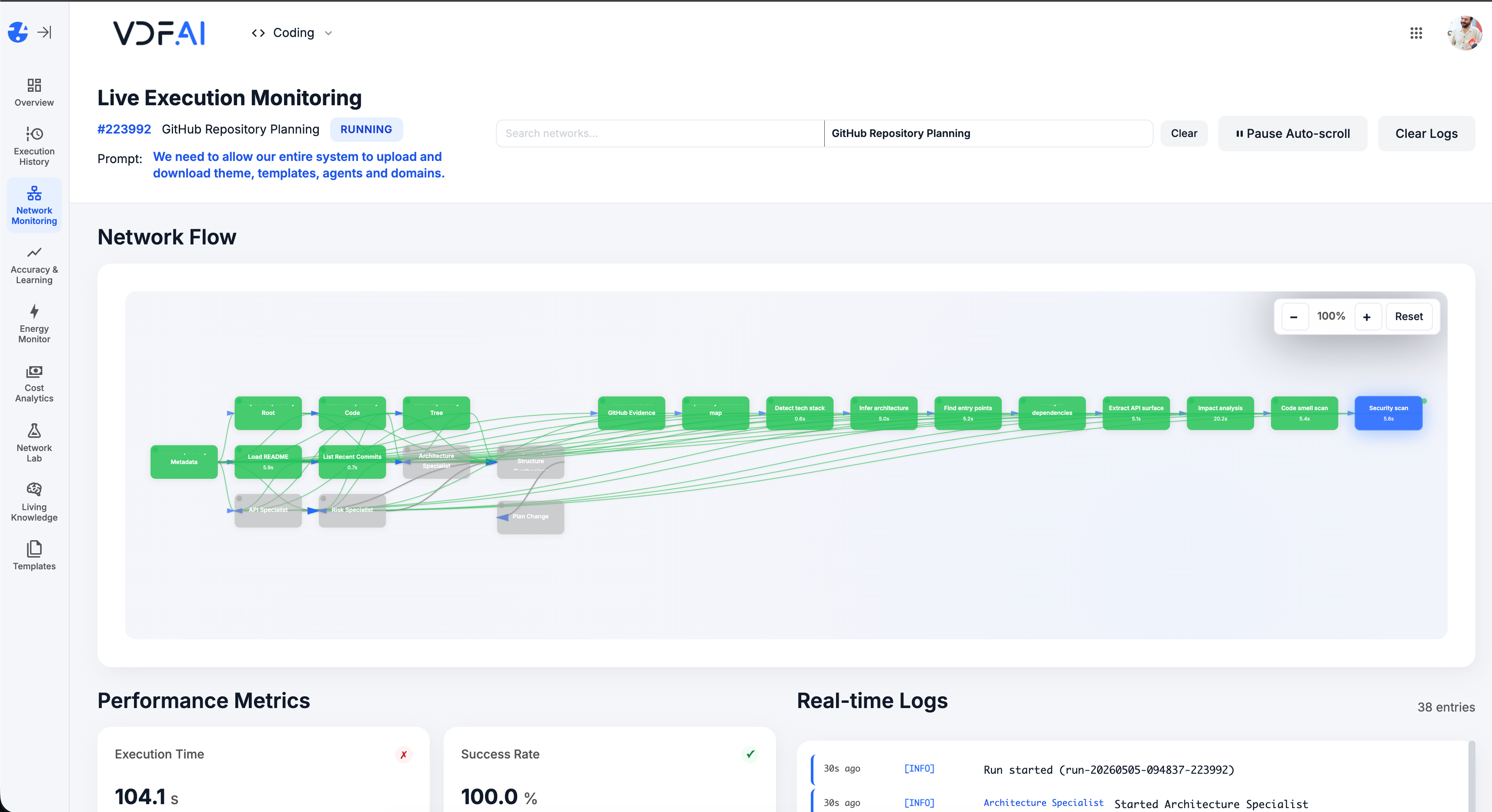
Live Execution Monitoring stores tool calls, model decisions, and citations. Reviewers can replay any case.
OUTCOMES
Reviewers focus on real exceptions
average case triage time.
cases ship with a complete evidence pack to the reviewer.
every decision traceable to inputs, prompts, models, and tool calls.
SEEMR REFERENCE
Routing that respects risk
SEEMR learns which model handles routine identity checks cheaply and which to escalate. High-risk sub-intents stay on your private high-capability model; low-risk on energy-efficient SLMs.
FREQUENTLY ASKED QUESTIONS
What teams ask before shipping this playbook
Does VDF AI replace our sanctions screening provider?
No. Your sanctions provider remains the system of record. VDF AI calls it as a Custom HTTP tool, reasons over the result, and packages the evidence.
How are false positives handled?
The Sanctions Agent emits structured output with confidence and rationale. Low-confidence hits route to a reviewer queue. SEEMR learns from reviewer decisions and reduces noise over time.
Can the SAR drafter file the report directly?
It can prepare the SAR draft with all required FinCEN or EU sections. Filing remains a human action — by design.
Is this validated against model-risk frameworks?
VDF AI exposes every model selection, prompt, and tool call. That transparency is the foundation for SR 11-7-style validation. Most institutions add a model-risk checklist to the Accuracy Testing module.
How is PII protected?
All data and PII processing happens on-prem. Domains plus tool-level auth ensure only entitled agents can retrieve specific fields.
How long until the network is in production?
A pilot LOB typically reaches production in eight to twelve weeks. Multi-LOB rollouts run by line of business in parallel after the first.
RELATED PLAYBOOKS
Continue with related VDF AI patterns


GET IN TOUCH
You Have Questions
Tell us what you’re trying to achieve—governed AI Networks, enterprise RAG, deep integrations, or on‑premise deployment. We’ll help you map the right architecture, security posture, and rollout path. If you’re moving beyond AI pilots and need scalable, auditable execution, reach out—our team is ready to help.