PLAYBOOK · MIGRATION
Migrate a LangChain or LangGraph app to a governed VDF AI Network.
LangChain and LangGraph are great prototyping libraries but uncomfortable production runtimes for regulated workloads. This playbook keeps your tools and prompts and replaces the runtime with VDF AI Networks — gaining SEEMR routing, observability, and on-prem governance.
LangChain and LangGraph are great for prototyping. They are uncomfortable for production at regulated scale — role-based access, on-prem deployment, energy tracking, and routing intelligence are not library features. This playbook shows a pragmatic migration path: keep your tools and prompts, replace the runtime, gain SEEMR routing and full observability.
The problem
Prototypes outgrow Python notebooks
LangChain and LangGraph excel at fast iteration. They struggle when the team wants role-based access, on-prem deployment, energy tracking, and SEEMR-grade routing — things the library was never designed to deliver.
The VDF AI approach
Replace the runtime, keep the work
Your tools, prompts, and retrievers come over as VDF AI tools, agents, and indexes. The runtime becomes a Network in Network Labs — governed, observed, and self-improving.
WHY THIS MATTERS NOW
The migration is from library to platform
A LangChain or LangGraph project is essentially a Python program that orchestrates LLM calls. That works until the moment it has to be governed, monitored, and explained to a compliance reviewer. Then the library shows its origins as a prototyping tool.
VDF AI offers a one-to-one mapping. Tools become Custom HTTP tools. Chains become Agents. Graphs become Networks. Retrievers become Vector Indexes. The migration preserves the work; it changes the runtime.
WHAT YOU NEED TO START
Prerequisites for a pilot
Source project
- LangChain or LangGraph repo with tests
- Working prompts and tools
- Existing retrieval sources
- Evaluation harness or golden set
Target environment
- VDF AI deployment
- Same source systems available
- Identity and SSO configured
- Network Labs canvas access
People
- One engineer who built the LangChain app
- One Network Labs owner
- One data engineer
- Optional: a DevEx lead for tooling
REFERENCE ARCHITECTURE
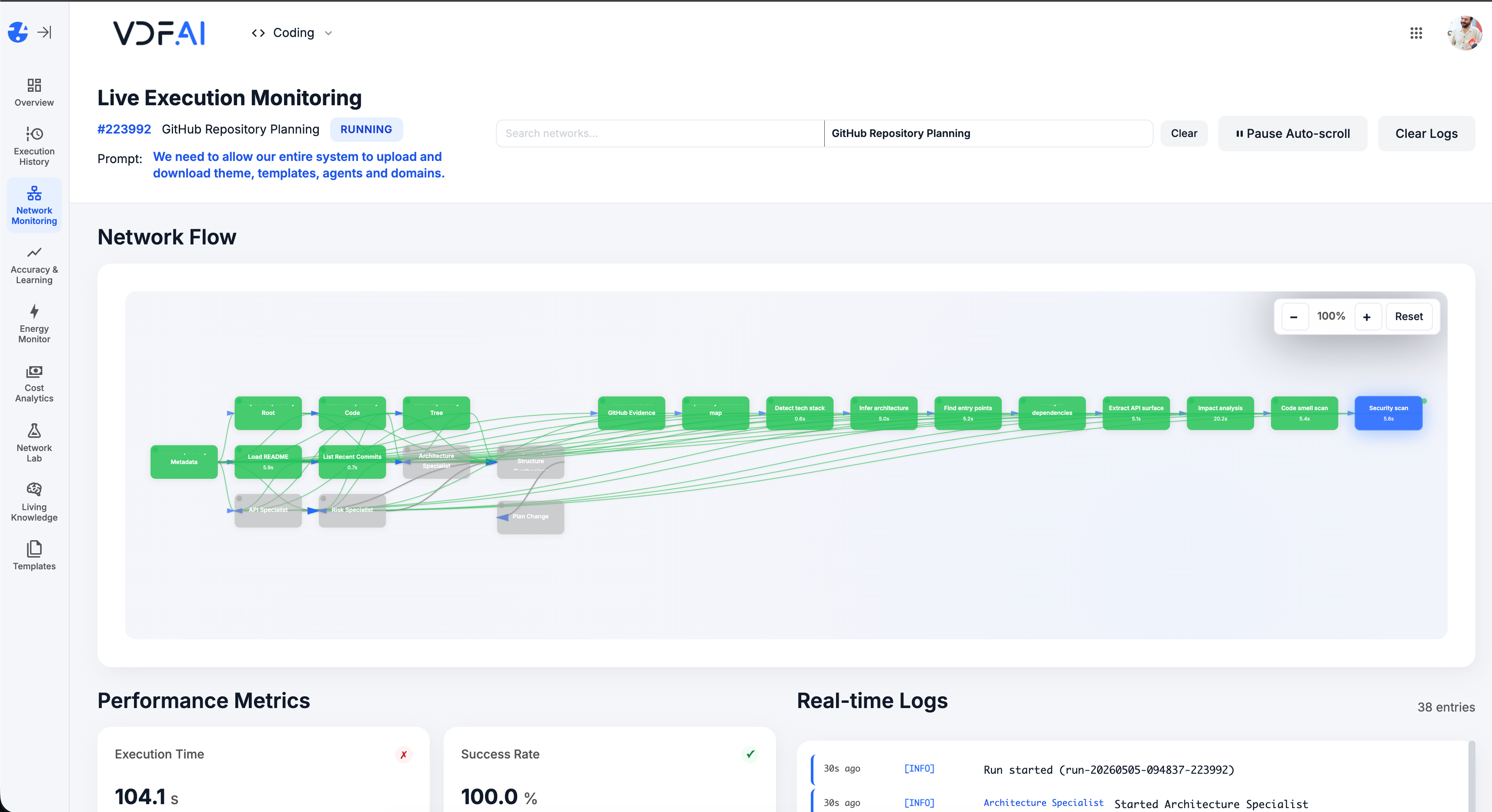
The mapping at a glance
Network Labs canvas
PLAYBOOK · STEP BY STEP
Migration without throwing away work
Inventory tools, prompts, and retrievers
List every LangChain tool, prompt template, and retriever. That list is the migration backlog.
Re-register each tool
Either keep the underlying Python and expose it as a Custom HTTP tool, or replace it with a built-in MCP tool from the 44 shipped with Agent Hub.
Recreate retrievers in VDF Data
Index the same sources into pgvector. The Vector DB Builder gives you a richer retrieval surface than most LangChain vector stores.
Rebuild the graph in Network Labs
Drag your chain or LangGraph into Network Labs as agents + edges. Explicit conditions, fallbacks, and live test runs replace fragile Python state.
Cut over and observe
Route a slice of traffic to the new Network. Live Execution Monitoring shows tool calls, model routes, and timings. SEEMR starts learning immediately.
OUTCOMES
From library to platform
tools and prompts preserved — no logic rewritten.
SEEMR routing, audit logs, energy tracking, role-based access.
runtime where it has to be — no library lock-in.
SEEMR REFERENCE
Library code can't route — SEEMR can
LangGraph picks the next step by code. SEEMR picks based on outcomes, cost, energy, and capability — and keeps learning across runs.
FREQUENTLY ASKED QUESTIONS
What teams ask before shipping this playbook
How much code do we throw away?
Usually the orchestration Python only. Tools, prompts, and retrieval logic come over as configuration.
Can we run both in parallel during migration?
Yes. Most teams run side-by-side with shadow traffic until the VDF AI version matches or beats the LangChain version.
What about LangSmith-style observability?
Live Execution Monitoring is the equivalent — and it ships with the platform.
Will SEEMR change the behavior of our prompts?
Indirectly, yes — by choosing different models for different sub-intents. The prompts themselves are unchanged.
How are LangGraph state machines mapped?
Edges and conditions become explicit in Network Labs. State persistence uses VDF AI's built-in run context, not custom code.
How long does a typical migration take?
Two to six weeks depending on project size. The biggest variable is how many tools have to be wrapped vs. swapped for built-in MCP tools.
RELATED PLAYBOOKS
Continue with related VDF AI patterns
GET IN TOUCH
You Have Questions
Tell us what you’re trying to achieve—governed AI Networks, enterprise RAG, deep integrations, or on‑premise deployment. We’ll help you map the right architecture, security posture, and rollout path. If you’re moving beyond AI pilots and need scalable, auditable execution, reach out—our team is ready to help.